C2 summary

Chapter 1 summary - Algebra and functions
- If {\rm f}(x) is a polynomial and {\rm f}(a)=0, then (x-a) is a factor of {\rm f}(x).
- If {\rm f}(x) is a polynomial and \displaystyle {\rm f}\left({b\over a}\right)=0, then (ax-b) is a factor of {\rm f}(x).
- If a polynomial {\rm f}(x) is divided by (ax-b) then the remainder is \displaystyle {\rm f}\left({b\over a}\right).
Chapter 2 summary - The sine and cosine rule
- The sine rule
\displaystyle {a\over \sin A} = {b\over \sin B} = {c\over \sin C} or \displaystyle {\sin A\over a} = {\sin B\over b} = {\sin C\over c}
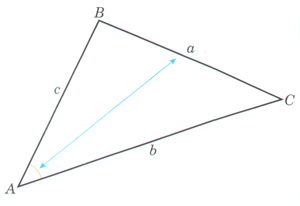
- You can use the sine rule to find an unknown side in a triangle if you know two angles and length of one of their opposite sides.
- You can use the sine rule to find an unknown angle in a triangle if you know the lengths of two sides and one of their opposite angles.
- The cosine rule is
a^2 = b^2 + c^2 - 2bc\cos A or b^2 = a^2 + c^2 - 2ac\cos B or c^2 = a^2 + b^2 - 2ab\cos C - You can use the cosine rule to find an unknown side in a triangle if you know the lengths of two sides and the angle between them.
- You can use the cosine rule to find an unknown angle if you know the lengths of all three sides.
- You can find an unknown angle using a rearranged form of the cosine rule:
\displaystyle \cos A = {b^2+c^2-a^2\over 2bc} or \displaystyle \cos B = {a^2+c^2-b^2\over 2ac} or \displaystyle \cos C = {a^2+b^2-c^2\over 2ab} - You can find the area of a triangle using the formula
area = {1\over 2}ab\sin C
if you know the length of two sides (a and b) and the value of the angle C between them.
Chapter 3 summary - Exponentials and logarithms
- A function y=a^x, or {\rm f}(x)=a^x, where a is a constant, is called an exponential function.
- \log_a n = x means that a^x = n, where a is called the base of the logarithm.
- \log_a 1 = 0
\log_a a = 1 - \log_{10} x is sometimes written as \log x.
- The laws of logarithms are
\log_a xy = \log_a x + \log_a y (the multiplication law) \displaystyle \log_a \left({x\over y}\right) = \log_a x - \log_a y (the division law \log_a (x)^k = k\log_a x (the power law) - From the power law,
\displaystyle \log_a \left({1\over x}\right) = -\log_a x - You can solve an equation such as a^x=b by first taking logarithms (to base 10) of each side.
- The change of base rule for logarithms can be written as \displaystyle \log_a x = {\log_b x\over \log_b a}
- From the change of base rule, \displaystyle \log_a b = {1\over \log_b a}
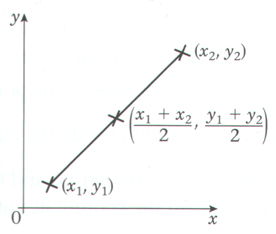
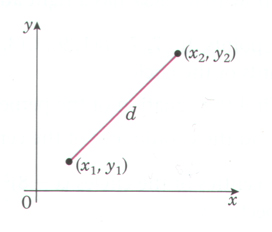
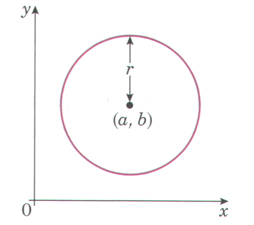
Chapter 4 summary - Coordinate geometry in the (x,y) plane
|
 |
|
 |
|
 |
|
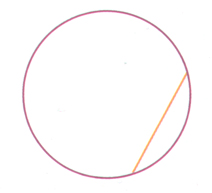 |
|
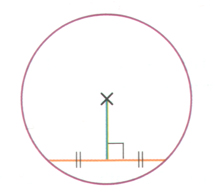 |
|
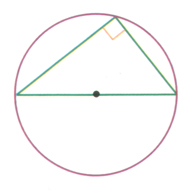 |
|
 |
|
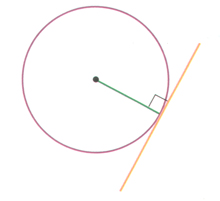 |
Chapter 5 summary - The binomial expansion
- You can use Pascal’s Triangle to multiply out a bracket.
- You can use combinations and factional notation to help you expand binomial expressions. For larger indices it is quicker than using Pascal’s Triangle.
- n! = n \times (n-1) \times (n-2) \times (n-3) \times ... \times 3 \times 2 \times 1
- The number of ways of choosing r items from a group of n items is written ^nC_r or \displaystyle {n\choose r}.
\displaystyle ^3C_2 = {3!\over (3-2)!2!} = {6\over 1 \times 2} = 3 - The binomial expansion is
(a+b)^n = {}^nC_0a^n + {}^nC_1a^{n-1}b + {}^nC_2a^{n-2}b^2 + {}^nC_3a^{n-3}b^3 + ... + {}^nC_nb^n
or \displaystyle {n\choose 0}a^n + {n\choose 1}a^{n-1}b + {n\choose 2}a^{n-2}b^2 + {n\choose 3}a^{n-3}b^3 + ... + {n\choose n}b^n - Similarly,
(a+bx)^n = {}^nC_0a^n + {}^nC_1a^{n-1}bx + {}^nC_2a^{n-2}b^2x^2 + {}^nC_3a^{n-3}b^3x^3 + ... + {}^nC_nb^nx^n
or \displaystyle {n\choose 0}a^n + {n\choose 1}a^{n-1}bx + {n\choose 2}a^{n-2}b^2x^2 + {n\choose 3}a^{n-3}b^3x^3 + ... + {n\choose n}b^nx^n - \displaystyle (1+x)^n = 1 + nx + {n(n-1)\over 2!}x^2 + {n(n-1)(n-2)\over 3!}x^3 + {n(n-1)(n-2)(n-3)\over 4!}x^4 + ...
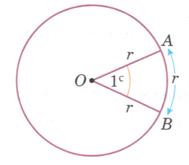
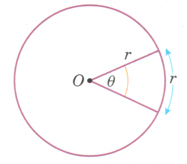
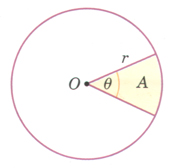
Chapter 6 summary - Radian measure and its applications
|
 |
|
|
|
 |
|
 |
|
|
Chapter 7 summary - Geometric sequences and series
- In a geometric series you get from one term to the next by multiplying by a constant called the common ratio.
- The formula for the nth term = ar^{n-1} where a = first term and r = common ratio.
- The formula for the sum to n terms is
\displaystyle S_n = {a(1-r^n) \over 1-r} or \displaystyle S_n = {a(r^n-1) \over r-1} - The sum to infinity exists if |r| < 1 and is \displaystyle S_\infty = {a\over 1-r}
Chapter 8 summary - Graphs of trignometric functions
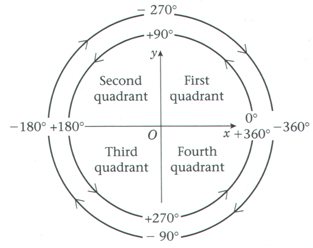
- The x-y plane is divided into quadrants:
|
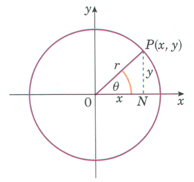 |
|
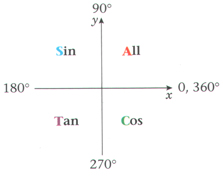 |
|
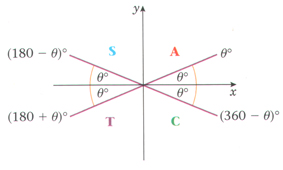 |
- The trignometric ratios of 30°, 45° and 60° have exact forms, given below:
\displaystyle \sin 30^\circ = {1\over 2} \displaystyle \cos 30^\circ = {\sqrt {3}\over 2} \displaystyle \tan 30^\circ = {1\over \sqrt {3}} = {\sqrt {3}\over 3} \displaystyle \sin 45^\circ = {1\over \sqrt {2}} = {\sqrt {2}\over 2} \displaystyle \cos 45^\circ = {1\over \sqrt {2}} = {\sqrt {2}\over 2} \displaystyle \tan 45^\circ = 1 \displaystyle \sin 60^\circ = {\sqrt {3}\over 2} \displaystyle \cos 60^\circ = {1\over 2} \displaystyle \tan 60^\circ = \sqrt {3} - The sine and cosine functions have a period of 360°, (or 2\pi radians).
Periodic properties are
\sin (\theta \pm 360^\circ) = \sin \theta and \cos (\theta \pm 360^\circ) = \cos \theta
respectively. - The tangent function has a period of 180°, (or \pi radians).
Periodic properties is \tan (\theta \pm 180^\circ) = \tan \theta - Other useful properties are
\sin (-\theta) = -\sin \theta; \cos (-\theta) = \cos \theta; \tan (-\theta) = -\tan \theta
\sin (90^\circ-\theta) = \cos \theta; \cos (90^\circ-\theta) = \sin \theta
Chapter 9 summary - Differentiation
- For an increasing function {\rm f}(x) in the interval (a, b), {\rm f}'(x)>0 in the interval a \leq x \leq b.
- For a decreasing function {\rm f}(x) in the interval (a, b), {\rm f}'(x)<0 in the interval a \leq x \leq b.
- The points where {\rm f}(x) stops increasing and begins to decrease are called maximum points.
- The points where {\rm f}(x) stops decreasing and begins to increase are called minimum points.
- A point of inflexion is a point where the gradient is at a maximum or minimum value in the neighbourhood of the point.
- A stationary point is a point of zero gradient. It may be a maximum, a minimum or a point of inflexion.
- To find the coordinates of a stationary point find \displaystyle {{\rm d}y\over {\rm d}x}, i.e. {\rm f}'(x), and solve the equation {\rm f}'(x)=0 to find the value, or values, of x and then substitute into y={\rm f}(x) to find the corresponding values of y.
- The stationary value of a function is the value of y at the stationary point. You can sometimes use this to find the range of a function.
- You may determine the nature of a stationary point by using the second derivative.
- In problems where you need to find the maximum or minimum value of a variable y, first establish a formula for y in terms of x, then differentiate and put the derived function equal to zero to find x and then y.
If \displaystyle {{\rm d}y\over {\rm d}x}=0 and \displaystyle {{\rm d}^2y\over {\rm d}x^2}<0, the point is a maximum point.
If \displaystyle {{\rm d}y\over {\rm d}x}=0 and \displaystyle {{\rm d}^2y\over {\rm d}x^2}=0, the point is either a maximum or a minumum point or a point of inflexion.
| Hint: In this case you need to use the tabular method and consider the gradient on either side of the stationary point. | ||
If \displaystyle {{\rm d}y\over {\rm d}x}=0 and \displaystyle {{\rm d}^2y\over {\rm d}x^2}=0, but \displaystyle {{\rm d}^3y\over {\rm d}x^3}\not= 0, then the point is a point of inflexion.
Chapter 10 summary - Trigonometrical identities and simple equations
- \displaystyle \tan \theta = {\sin \theta\over \cos \theta} (providing \cos \theta \not= 0, when \tan \theta is not defined)
- \sin^2 \theta + \cos^2 \theta = 1
- A first solution of the equation \sin x = k is your calculator value, \alpha = \sin^{-1} k. A second solution is (180^\circ - \alpha), or (\pi - \alpha) if you are working in radians. Other solutions are found by adding or subtracting multiples of 360° or 2\pi radians.
- A first solution of the equation \cos x = k is your calculator value, \alpha = \cos^{-1} k. A second solution is (360^\circ - \alpha), or (2\pi - \alpha) if you are working in radians. Other solutions are found by adding or subtracting multiples of 360° or 2\pi radians.
- A first solution of the equation \tan x = k is your calculator value, \alpha = \tan^{-1} k. A second solution is (180^\circ + \alpha), or (\pi + \alpha) if you are working in radians. Other solutions are found by adding or subtracting multiples of 360° or 2\pi radians.
Chapter 11 summary - Integration
- The definite integral \displaystyle \int_a^b {\rm f}'(x){\rm d}x = {\rm f}(b) - {\rm f}(a).
- The area beneath the curve qith equation y={\rm f}(x) and between the lines x=a and x=b is
Area \displaystyle = \int_a^b {\rm f}(x){\rm d}x
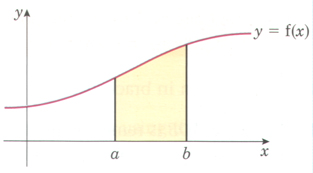
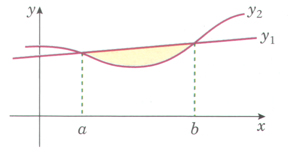
- The area between a line (equation y_1) and a curve (equation y_2) is given by
Area \displaystyle = \int_a^b (y_1-y_2){\rm d}x
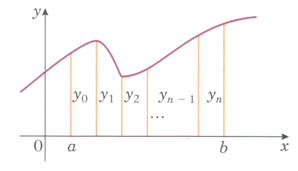
- Trapezium rule (in the formula booklet):
\displaystyle \int_a^b y {\rm d}x \approx {1\over 2}h [y_0 + 2(y_1 + y_2 + ... + y_{n-1}) + y_n]
where \displaystyle h = {b-a\over n} and y_i = {\rm f}(a+ih).
|
http://maths.adibob.comk/ This site is not endorsed by Heinemann or edexcel in any way. Site produced by Adrian Lowdon. Email adi@adibob.com |