M1 summary

Chapter 1 summary - Mathematical models in mechanics
This chapter does not have a summary.Chapter 2 summary - Vectors and their application in mechanics
- Scalar quantities are completely specified by their magnitude.
- Vector quantities require both their size (magnitude) and direction to be specified.
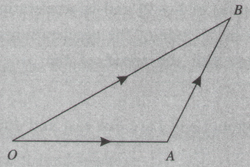
- Vectors are added by using the triangle law of addition:
\overrightarrow {OB} = \overrightarrow {OA} + \overrightarrow {AB}
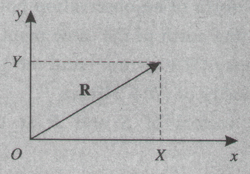
- Using the {\bf i},{\bf j} notation:
{\bf R} = X{\bf i}+Y{\bf j}
- If particle A has position vector {\bf r}_A and particle B has position vector {\bf r}_B then the position vector of B relative to A is {\bf r}_B - {\bf r}_A.
- If particle A has velocity {\bf v}_A and particle B has velocity {\bf v}_B then the velocity of B relative to A is {\bf v}_B - {\bf v}_A.
Chapter 3 summary - Kinematics of a particle
- Constant acceleration
For a particle moving with constant acceleration:
v = u+at
\displaystyle s = \left({u+v\over 2}\right)t
s = ut + {1\over 2}at^2
v^2 = u^2 + 2as - Speed-time graphs
The area under a speed-time graph in a given time interval is the distance travelled during that time.
The gradient of a speed-time graph is the acceleration of the moving particle.
Chapter 4 summary - Statics of a particle
- Force is a vector quantity.
- Forces can be added by using the triangle law or parallelogram rule.
- The resultant of a system of forces is most easily found by using components.
- A system of forces is in equilibrium if their lines of action pass through a single point and if their resultant is the zero vector.
- The magnitude of the frictional force is just sufficient to prevent relative motion.
- For a smooth surface there is no frictional force (F=0).
- When sliding occurs the frictional force takes its limiting value \mu R and opposes the relative motion.
Chapter 5 summary - Dynamics of a particle moving in a straight line or plane
- Newton's Laws of Motion
- A particle will only accelerate if it is acted on by a resultant force.
- The force F applied to a particle is proportional to the mass m of the particle and the acceleration produced.
{\bf F} = m {\bf a} - The forces between two bodies in contact are equal in magnitude but opposite in direction.
- Momentum and Impulse
The momentum of a particle of mass m moving with velocity {\bf v} is m{\bf v}.
If a constant force {\bf F} acts on a particle for time t, then the impulse of the force is equal to {\bf F}t.
Impulse = change in momentum
For a force in Newtons and time in seconds, impulse and momentum are measured in Newton-seconds. - Conservation of momentum
Momentum is conserved for two particles experiencing a collision or jerk where there are no external forces involved.
m_1u_1 + m_2u_2 = m_1v_1 + m_2v_2
Chapter 6 summary - Moments
- The moment of a force of magnitude F about a point P is given by:
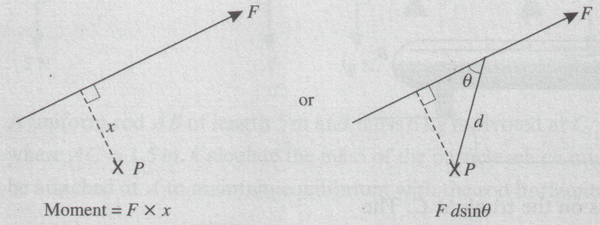
For a force in Newtons and a distance in metres the moment is measured in Newton-metres (Nm).
Moments can be clockwise or anticlockwise in sense. - For a lamina to be in equilibrium under parallel forces:
- the resultant force in any direction must be zero
- the component of the resultant force in any direction must be zero
- the algebraic sum of the moments about any point must be zero.
- A rod which is in equilibrium resting on two supports at the same horizontal level is said to be on the point of tilting about one support when the reation at the other support has magnitude zero.
|
http://maths.adibob.com/ This site is not endorsed by Heinemann or edexcel in any way. Site produced by Adrian Lowdon. Email adi@adibob.com |